Ghosting the Spectre
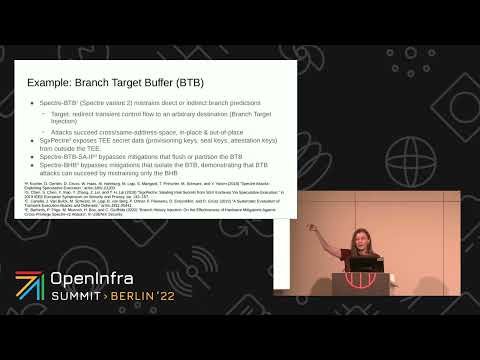
summary
Research prototypes three concrete hardware approaches: RISC-V cores synthesized on Amazon FPGAs via Firesim/FireMarshall to measure costs and protections. Mitigations compared are isolation, flushing, and disabling speculation. One design pairs heterogeneous speculative and non‑speculative cores, one is fully non‑speculative (complete protection with a measured 30–60% performance penalty), and one adds a non‑speculative ISA extension to selectively disable speculation per VM or process, showing finer-grained control and better tradeoffs than global data-center defaults.
AI-written summary · about
chapters (8)
- 0:00Introduction and background
- 1:05Spectre and Meltdown overview
- 8:29Zone of risk in speculation
- 15:07Historical context and trust issues
- 21:29Trust in multi-tenant computing
- 23:13Prototype solutions and performance
- 27:44Future hardware and community involvement
- 30:39Q&A on mitigation techniques
related talks
 17mSecuring High-performance RISC V-Processors from Time Speculation
 46mRethinking Architectures and Abstraction for a World Where Security Improvements Matter More than Performance Gains
 01h 28m“Spectre: Secrets, Side-Channels, Sandboxes, and Security”
 56mSpectre/C++
 12mHardware Verification of Timing Side Channel Freedom in the Spectre Era
 25mExorcising Spectres with Secure Compilers
 18mHardware-Software Codesign for Mitigating Spectre
 47mMill vs. Spectre: Performance and Security