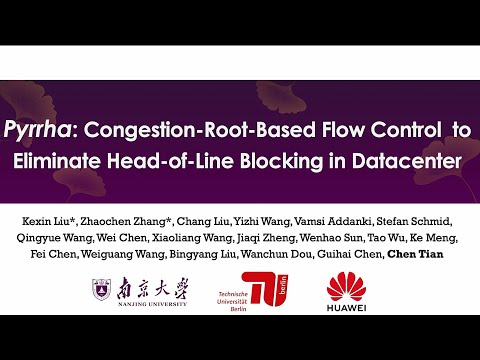
Pyrrha: Congestion-Root-Based Flow Control to Eliminate Head-of-Line Blocking in...
summary
Claims a flow-control granularity tied to the congestion-root ID that provably eliminates head‑of‑line blocking by allocating isolation queues only for flows that actually route through the congested port, using a distributed route‑election and merge protocol. Prototype runs on Tofino2 and uses ~40% memory to support ~10,000 hosts; worst‑case per‑port queue usage stays under 20 queues. Reported results: 42%–98% average FCT reduction for uncongested flows and 1.6×–215× lower 99th‑percentile latency.
AI-written summary · about
chapters (7)
- 0:00Pyrrha introduction
- 2:02Per-hop flow control benefits
- 3:49Drawbacks of PFC
- 6:41Congestion root insight
- 8:55Pyrrha protocol design
- 14:16Implementation and performance
- 15:42Conclusion and future
related talks
 16mBackpressure Flow Control
 16mFLB: Fine-grained Load Balancing for Lossless Datacenter Networks
 16mFlow Scheduling with Imprecise Knowledge
 16mManaging Congestion Control Heterogeneity on the Internet with Approximate Performance...
 16mBuilding A CSFQ-Inspired Transport for Switched CXL Memory Pooling
 16mGRO Library Enhancements
 16mFRCC: Towards Provably Fair and Robust Congestion Control
 21mYour Coflow has Many Flows: Sampling them for Fun and Speed