Fair And Reliable Machine Learning For High-Stakes Applications:approaches Using Information Theory
summary
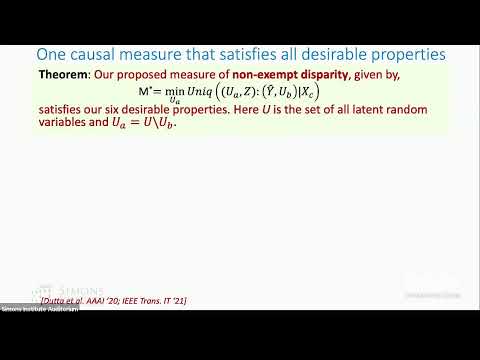
Proposes a principled measure of non‑exempt disparity that combines partial information decomposition with causal models, because conditional mutual information can falsely flag bias while unique information vanishes for causally fair predictors. Shows unique information still fails on XOR/mass‑discrimination cases, so a causal synthesis is required (and depends on the true SCM). Proves no purely observational metric meets all axioms, validates observational proxies on synthetic and real data (including CMU admissions), and analyzes accuracy–fairness tradeoffs via churn‑off information.
AI-written summary · about
chapters (11)
- 0:00Introduction
- 2:17Unintended Consequences
- 3:04Example
- 5:01Problem Statement
- 6:37Counter Example
- 8:02Partial Information Decomposition
- 8:39Unique Information
- 12:04Impossible Results
- 12:39Filter Bubbles
- 13:17Quantifying Fairness
- 13:37Summary
related talks
 37mAlgorithmic Fairness From The Lens Of Causality And Information Theory
 42mFairness in Machine Learning: From Theory to Practice
 34mInterpretability and Algorithmic Fairness
 51mDigital Discrimination: Cognitive Bias in Machine Learning
 28mMeasuring Model Fairness
 46mA look at the methods to detect and try to remove bias in ML models
 46mThe Measure and Mismeasure of Fairness
 37mKeynote: Ethical Machine Learning: Creating Fair Models in an Unjust World