Algorithmic Fairness From The Lens Of Causality And Information Theory

summary
Proposes a concrete measure of non-exempt disparity that separates bias explainable by chosen critical features from bias that is not, using causality plus Partial Information Decomposition and an observational lower bound called unique information. Shows conditional mutual information falsely flags fairness in simple causal examples while the causal unique information matches intuitive judgments, and exposes masking cases that force a latent-variable causal measure; methods validate on simulations and guide regularized training.
AI-written summary · about
chapters (13)
- 0:00Intro
- 0:34Motivation: Machine Learning in High-Stakes Applications
- 1:52How to identify/explain sources of disparity in machine learning models?
- 4:32Outline
- 7:39Popular Definition: Statistical Parity
- 11:35Conditional Dependence can sometimes falsely detect bias (misleading dependencies) even when a model is "causally" fair Example: Causally fair model
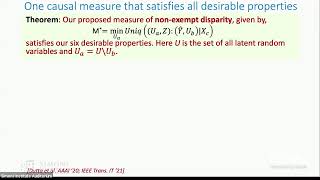
- 17:42One causal measure that satisfies all desirable properties Theorem: Our proposed measure of non-exempt disparity, given by
- 20:01Some intuition on our proposed measure from causality
- 22:13Non-negative decomposition of total "causal" disparity Theorem 2 (pictorially illustrated)
- 24:11Simulation: Four types of disparities present
- 29:17Numerical Computation of Fundamental Limits on the Tradeoff 1.4
- 30:34Reliable Machine Learning
- 31:25Partial Information Decomposition + Causality
related talks
 14mFair And Reliable Machine Learning For High-Stakes Applications:approaches Using Information Theory
 34mInterpretability and Algorithmic Fairness
 42mFairness in Machine Learning: From Theory to Practice
 51mDigital Discrimination: Cognitive Bias in Machine Learning
 28mMeasuring Model Fairness
 53mGroups and Individuals in Fairness and Probability
 50mThe Measure and Mismeasure of Fairness
 35mOpen Source Fairness