Fundamental Limits Of Learning In Data-Driven Problems
summary
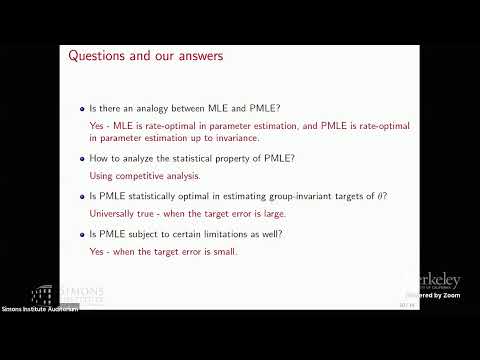
Proves exact minimax rates for entropy estimation without a positive density lower bound and achieves them via a two-stage approximation that handles vanishing f regions; analyzes the profile MLE, proving it is optimal for group-invariant estimation but incurs an explicit penalty with a sharp n^{-1/3} threshold and requires a competitive analysis rather than classical expansions; develops bidding algorithms for first-price auctions that exploit the reward/feedback interplay, obtain optimal regret in many settings and are deployed by Verizon Media DSP.
AI-written summary · about
chapters (13)
- 0:00Intro
- 0:35Motivation
- 1:12Example: dynamic assortment optimization
- 1:35Why fundamental limit counts
- 3:45Example 1: nonparametric entropy estimation
- 4:08Rich line of prior research
- 5:00Our results
- 6:00Example II: theory of the profile MLE
- 7:03Profile and PMLE
- 8:09Questions and our answers
- 10:03Example III: learning to bid in first-price auctions
- 10:38Bidder's challenge
- 13:22My research picture
related talks
 53mOptimality in Locally Private Estimation and Learning
 55mLearning Minimax Estimators Via Online Learning
 29mOn Learning Distributions from their Samples
 01h 08mData Driven Optimization Models and Algorithms
 32mLearning Reserve Prices in Second-Price Auctions
 31mStrong Data Processing Inequalities and Estimation with Constraints
 01h 28mMulti-Distribution Learning, for Robustness, Fairness, and Collaboration
 29mPure Exploration Problems