Quantum Necromancy and the Hardness of Observing Schrodinger's Cat
summary
Proves that detecting coherence between orthogonal branches requires the computational ability to swap alive and dead: if a T‑gate circuit distinguishes |alive>+|dead> from |alive>-|dead> then roughly T gates suffice to swap the two branches, so verifying a Schrödinger cat demands reviving the dead cat. Introduces swap complexity as the right measure, shows an exponential separation from relative state complexity, gives unconditional limits and a complexity‑theoretic corollary (if PSPACE ⊄ PP/poly then no polynomial‑time experiment can see interference between early and extremely late AdS/CFT states).
AI-written summary · about
chapters (4)
- 0:00Intro
- 0:42Schrödinger's Cat and Quantum Necromancy
- 6:11Lenny's Conjecture is (basically) True! [Aaronson, A., Susskind, arXiv:2009.07450] Theorem 1: Given two orthogonal states Alive and Dead , suppose there's a quantum circuit with t gates to distinguish (say) Alive +|Dead from Alive -Dead . Then there's also a quantum circuit with t gates to swap the Alive and Dead states (and vice versa).
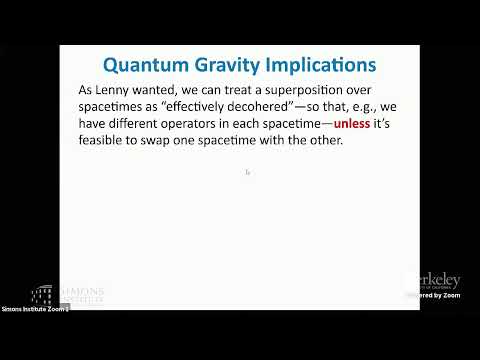
- 9:50Foundational Implications To some extent, our result just "formalizes the folklore": interference between branches stops being detectable precisely when irreversibility sets in. We show that Irreversibility is equivalent to swapping one branch with the other
related talks
 06mLightning Talk: Quantum Computing and Superpositional Cats
 53mFundamental limits to quantum computation
 45mClassical Verification of Quantum Computational Advantage
 44mQuantum Meets Minimum Circuit Size Problem
 29mEfficiently Verifying Quantum Programs with Few T Gates
 01h 00mQuantum Physics for Software Developers
 01h 10mQuantum Advantage with Shallow Clifford Circuits
 01h 08mPutting Quantum Supremacy on a Rigorous Footing