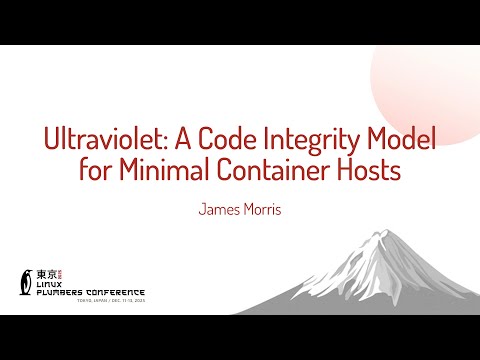
Ultraviolet: A Code Integrity Model for Minimal Container Hosts
summary
Ultraviolet proposes an end-to-end, policy-driven launch-time code integrity model for minimal container hosts that extends secure boot and a hardware root of trust into the OS. It combines Integrity Policy Enforcement (IPE), DM-Verity signed images, mandatory access control (SELinux), script-execution control and a mostly immutable layout on a ParticleOS/rawhide reference build. It targets binaries, scripts, kernel modules, firmware and BPF, enforces state separation between read-only images and writable data, and draws on a production lineage that scaled to multiple millions of nodes.
AI-written summary · about
chapters (8)
- 0:00Introduction and background
- 1:03What is Ultraviolet project
- 3:53Threat environment and goals
- 7:24Code integrity requirements
- 10:41Container host architecture
- 12:30State separation model
- 15:45Production experience and references
- 17:12Q&A session
related talks
 30mFinding Imposter Among Us: Container Edition
 29mZero-Trust Containers: Rethinking Security in the Age of Ephemeral...
 08mIn Containers We Trust? Building Trust in Containerized Environments
 42mSecuring Filesystem Images for Unprivileged Containers
 45mMaking Containers Safer
 43mTowards Secure Unified Kernel Images for Generic Linux Distributions and Every...
 06mLightning Talk: Security Down to the Kernel
 43mThe Power of Application Intent Analysis for Container Security [I]