IEEE CoG 2019 - Industry Day - Paul Schelter (Ubisoft)
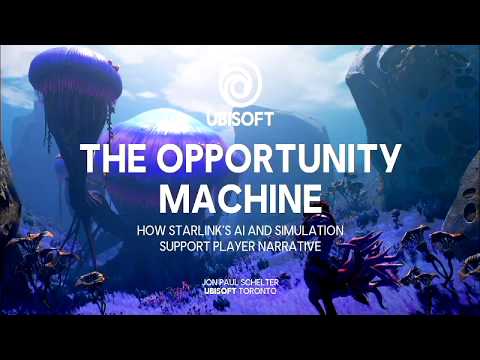
summary
A procedurally generated star system is backed by an always-on simulation that doubles as the save game and runs asynchronously on its own core, updating about 5000 sim units per frame so a planet takes ~200 ms and the whole system ~2 s to refresh; the world holds roughly 100,000 sim units (agents, squads, structures, POIs). Planets are small spheres (≈3.5 km radius, ~160 km² playable) and content generation runs offline at development time; this setup reliably surfaces emergent missions and scales to a ~100-person team.
AI-written summary · about
chapters (8)
- 0:00Introduction to StarLink
- 3:58Prototyping the game
- 7:57Simulating living worlds
- 11:38Simulation prototype demo
- 18:20Creating NPC variety efficiently
- 27:15Making sense of the simulation
- 37:20Balancing simulation and narrative
- 44:48Key takeaways and conclusion
related talks
 51mEngineering Live Ops on Call of Duty: WWII
 18mGram Games on iterating your development pipeline as you grow
 30mProduction › Prototype: How a Small Team Replaced a Core Platform in 90 Days
 16mGame-changing Engineering
 11mUnity Solutions: Customer-oriented R&D
 30mBuilding the systems that build the software
 12mHow do you deliver a feature on the biggest stage in the world?
 45mTools and Infrastructure for Large Teams