Whole Genome Methylation Patterns as a Biomarkers for EHR Imputation
summary
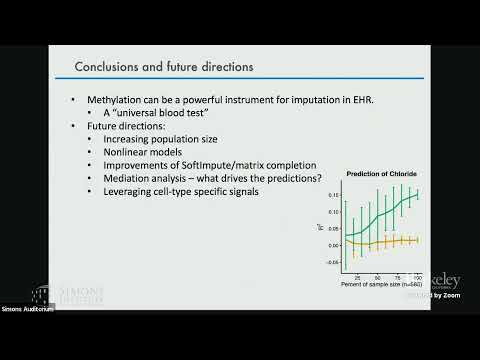
Whole‑genome blood methylation yields measurable imputation gains over genetics and simple baselines using only ~800 biobank samples, with the biggest wins on kidney‑related labs and diagnoses and decile enrichment where MRS outperforms PRS on many labs and diagnoses. Methylation captures recent months of exposure and demographics, it boosts matrix completion when appended to the data matrix and nonlinear gene‑focused neural nets show promise, though results need scaling to 10,000+ samples for robust population inference and transfer.
AI-written summary · about
chapters (13)
- 0:00Intro
- 0:57Disease Prediction
- 4:11Electronic Health Records - Addressing Sparsity
- 9:09PRS - Limitations
- 10:58Methylation as a biomarker
- 13:02Can we use methylation data for imputation
- 14:44Methylation Risk Score
- 16:29Population demographics
- 19:14Comparison with polygenic risk scores
- 21:04Comparison with matrix completion
- 21:23Timing vs. accuracy
- 26:12Non-linear models for chronic renal failure
- 27:50Conclusions and future directions
related talks
 20mAdvancing Epigenetic Predictors with Scalable Machine Learning
 01h 20mIntroduction to Regulatory Genomics and Epigenomics II: Motif Finding
 35mMachine Learning for Single-Cell 3D Epigenomics
 38mBig data in personalised medicine
 20mDiagnostic Medical application of ML
 33mNetwork Data Integration Enables Precision Medicine
 38mInterpreting Deep Learning Models Of Functional Genomics Data To Decode Regulatory Sequence...
 22mReimaging Healthcare