Diagnostic Medical application of ML
summary
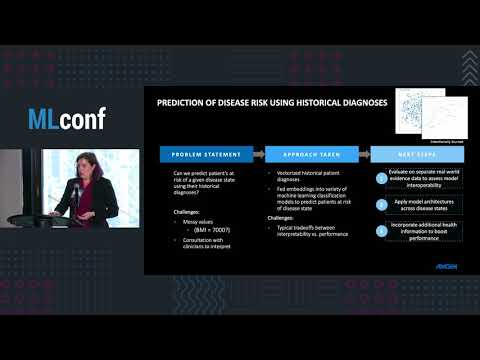
Amgen pilots machine vision with Zebra (FDA-cleared) to detect incidental vertebral compression fractures on CTs, finds labeling and workflow bottlenecks and is testing generalizability across hospitals and countries. Clinical-history models use ICD code embeddings (mapped ontology) to cluster comorbidities and predict future disease, despite messy entries (one BMI = 7000). Small, wide clinical trial sets (~1,000 patients × ~30,000 genes) use Bayesian networks for interpretable drivers, what‑if interventions and to handle sparsity/imputation challenges while sequencing costs decline.
AI-written summary · about
chapters (9)
- 0:00ML in healthcare diagnostics
- 1:58Healthcare data challenges
- 3:02Patient identification with ML
- 4:45ML-driven patient discovery impact
- 6:09Disease risk prediction
- 9:20Interpretability vs performance
- 10:45Bayesian networks for therapy
- 13:31Genomic data integration
- 14:38Regulatory on ML interpretability
related talks
 30mMachine Learning: A New Approach to Drug Discovery
 22mReimaging Healthcare
 26mShiva Amiri, CEO, BioSymetrics at MLconf Seattle 2017
 44mAI in the Clinic: Prediction is Better Than Cure
 37mAI in medicine: where do we stand?
 20mML applications in healthcare - Saudi Arabian hospital case study
 28mThe Future of Healthcare – AI’s Promise and the Challenges Ahead
 09mHow AI is changing the healthcare system