Multi-Omic Integration for Understanding Disease
summary
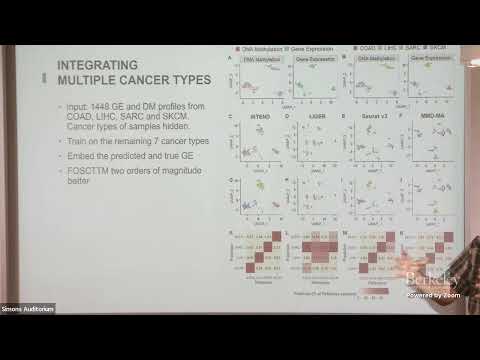
Benchmarks on 10 TCGA cancers using three omics (mRNA, miRNA, methylation) produce a kernel neighbor–based integrator called NEMO that averages per-omic relative similarities and then spectral clusters, yielding the most cancers with significant survival differences and handling missing data without imputation (example AML ~200 patients, 5 clusters). A complementary method Monet selects omics per cluster via hill-climbing and matches NEMO on outcomes. For cross-dataset integration a pipeline IntEnt fits per-gene LASSO models (2,000 top R2 genes) then CCA embedding and outperforms Liger/Seurat/mmDMA across 11 cancers.
AI-written summary · about
chapters (14)
- 0:00Start
- 1:33MULTI OMICS DATA: BONANZA ORA TOWER OF BABEL?
- 2:33I METHODS FOR MULTI-OMICS CLUSTERING
- 8:14PERFORMANCE: MEAN SIGNIFICANCE VALUES
- 8:51ACUTE MYELOID LEUKEMIA (AML)
- 11:15II. Multi-omic module discovery in cancer by omic selection
- 11:25Multi-omic clustering
- 12:09MONET Exhaustive Types
- 14:38Results: cancer Enrichment of known clinical parameters
- 14:56Application: clustering single cell multi-omic data
- 16:11Summary (2)
- 16:51III. TRANSFERRING OMICS ACROSS EXPERIMENTS
- 19:49RESULTS: I SINGLE CANCER TYPE
- 27:27INTEGRATING MULTIPLE CANCER TYPES
related talks
 33mUnderstanding Molecular Complexity for Precision Medicine
 29mMachine Learning Techniques for Omics Data Analysis
 33mNetwork Data Integration Enables Precision Medicine
 35mFrom cells to drug responses - machine learning in cancer research
 44mNetwork Propagation as a Tool for Deciphering Disease Mechanisms
 01h 31mIntroduction to Cancer Bioinformatics I: Inferring Genomic Variation from Tumor Sequencing Data
 28mHow ML can Help Tailor Immunotherapies to Cancer Patients
 32mHow machine learning helps cancer research