Breaking the Winner's Curse in Mendelian Randomization: Rerandomized Inverse Variance...

summary
Proposes a rerandomized inverse-variance weighted (RIVW) estimator that adds Gaussian noise to selection statistics, then constructs unbiased association estimates by projecting the noisy estimates onto the selection sufficient statistic (a Rao‑Blackwellization step) so selection and estimation become independent. Claims complete removal of the winner's curse and a small measurement‑error correction in the denominator. Shows asymptotic normality with estimable variance, Monte Carlo gains in power and lower variance, and two real examples where same‑trait returns 1 and BMI→COVID severity increases.
AI-written summary · about
chapters (16)
- 0:00Intro
- 1:24Mendelian Randomization: Popularity
- 1:42Effect of Smoking on Life Expectancy?
- 2:08What hinders our understanding? Confounding factor
- 4:50Mendelian Randomization (MR): Model Setup
- 8:10Two-sample MR in GWAS
- 10:30A Common Exercise Casts Winner's Curse
- 12:16Two-sample MR vs Three-sample MR with GWAS
- 13:57Winner's Curse in Simulation Studies: Results
- 16:06Bias of Inverse Variance Weighted Estimator
- 18:08Breaking the Winner's Curse with Randomized Selection
- 21:07Measurement Error Bias Correction
- 21:44Theoretical Guarantee
- 22:29Comparison in Simulation Studies
- 23:42Same Trait Analysis
- 24:56Today's talk
related talks
 13mAlgorithmic Advances For The Design And Analysis Of Randomized Control Trials
 43mRobustness in High-Dimensional Inference Tasks
 45mThe Statistical Fairness-Accuracy Frontier
 42mManualRivas
 57mA New Perspective on High-Dimensional Causal Inference
 33mBalancing Covariates In Randomized Experiments: The Gram--Schmidt Walk Design
 11mCausal Inference With Corrupted Data: Measurement Error, Missing Values, Discretization, And...
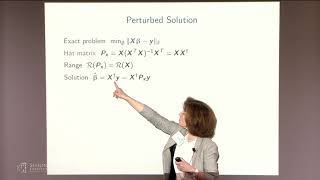 24mRandomized Least Squares Regression: Combining Model- and Algorithm-Induced Uncertainties