Testbed for Development of AI Solutions to Boost Operational Efficiency in Transportation Networks

summary
A SUMO + TraCI testbed is built and linked to Ray RLlib to train DRL agents (DQN and A2C) on a 2.6‑mile, four‑lane freeway with two exits using real traffic profiles. The environment uses 22 detectors, a 44‑element state (counts and speeds per 10‑minute step) and a 16‑action duty‑cycle vector for exit routing. Count‑based reward causes unstable training, a speed‑based surrogate stabilizes learning, and A2C outperforms DQN; transfer learning from regular to accident scenarios also proves effective.
AI-written summary · about
chapters (11)
- 0:00Introduction
- 2:00Motivation
- 4:30Prior work
- 6:25Contributions
- 8:22Architecture
- 9:23Test Case Description
- 13:42macroscopic fundamental diagram
- 15:12main results
- 16:40deployment results
- 17:00transfer learning results
- 17:47conclusions
related talks
 42mThe Importance of Open Simulators and AI in a Changing Mobility Landscape
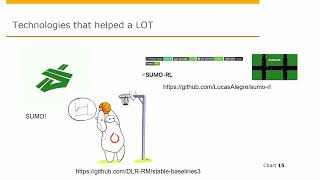 21mChallenges in Reward Design for Reinforcement Learning-based Traffic Signal Control
 20mAI on the Fast Lane: Smart Traffic Systems to Unclog our Cities
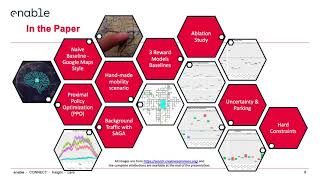 11mUsing Deep Reinforcement Learning to Coordinate Multi-Modal Journey Planning with Limited ...
 20mEnergy Optimized Green Light Assist in Varying Traffic Scenarios Using Reinforcement Learning
 45mKEYNOTE: Traffic simulation modeling: combining generative modeling with transportation science ...
 24mTowards Smarter Intersections Through Digital Twins - The Coupling of SUMO and SCENIMINI
 40mTeaching a Car to Drive Itself by Imitation and Imagination