Simulating platooned connected autonomous vehicle in a large scale urban scenario
summary
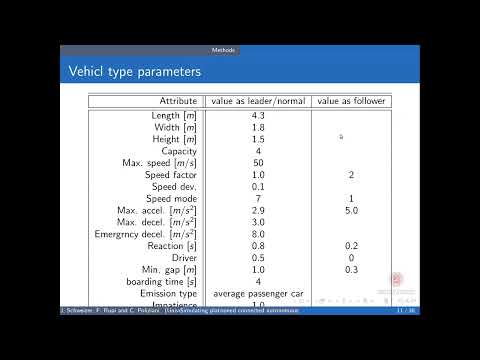
A city-scale rush-hour microsimulation replaces private cars with 100% CAV substitution using SUMO's SIMPLA + TRACI and SUMOPy demand, starting platoons only on shared routes >500 m and ≥3 common edges. Results show ~6% trip time reduction / ~5% fuel increase: peripheral speeds rise more (up to ~6%), core area gains ≈2%, fuel rises due to high catchup speeds. Model omits communication delays and sub-lane bike interactions, causes roundabout deadlocks, and assumes platoon stability; V2I/GLOSA and merge strategies are needed.
AI-written summary · about
chapters (7)
- 0:00Start
- 1:13Energy and Fuel Consumption
- 5:33Gps Traces from Bike Traffic
- 8:34Technical Details
- 11:23Dynamics
- 11:40Stability
- 17:39Results
related talks
 17mSimulation based method for the analysis of energy-efficient driving algorithms
 45mKEYNOTE: Traffic simulation modeling: combining generative modeling with transportation science ...
 42mThe Importance of Open Simulators and AI in a Changing Mobility Landscape
 18mSUMO Simulations for Federated Learning in Communicating Autonomous Vehicles
 19mCycle-Level Distribution-Based Calibration of Microscopic Intersection Models Using UAV Trajectories
 24mTowards Smarter Intersections Through Digital Twins - The Coupling of SUMO and SCENIMINI
 20mAI on the Fast Lane: Smart Traffic Systems to Unclog our Cities
 24mLeveraging Eclipse SUMO and Eclipse MOSAIC