Evaluating the Practical Capabilities of Contemporary Quantum Processors in Breaking AES Encryption
summary
Benchmarks of IBM, Google, Zuchongzhi 2, Microsoft, Rigetti, IonQ and Honeywell list gate counts, coherence times and connectivity and then translate those into realistic wall-clock attacks on AES. The claim is that Grover reduces AES‑128 to 2^64 effective search but practical execution needs thousands of logical qubits and error‑correction overhead ~10^3–10^4 physical qubits per logical qubit, so timelines hinge on scaling plus gate fidelity; IonQ/Honeywell ion traps show all‑to‑all connectivity that lowers circuit depth, but no current system meets the required qubit+error budgets.
AI-written summary · about
chapters (10)
- 0:00Welcome
- 1:28Quantum threats to AES
- 3:15NISQ era challenges
- 6:30Quantum processor tech
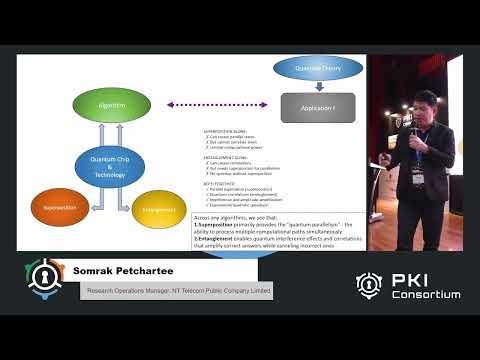
- 8:58Superposition and entanglement
- 10:26Compiler and transpiler roles
- 11:08Grover's algorithm improvements
- 12:57Grover's oracle and diffusion
- 13:41Parallelizing Grover ops
- 14:48AWS quantum processors for AES