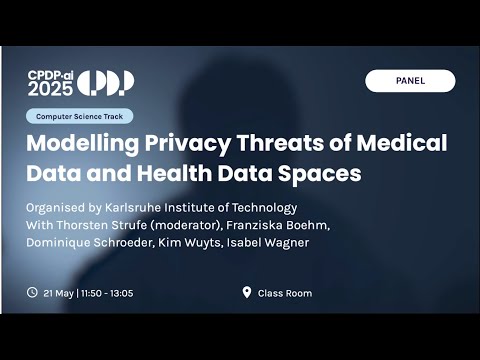
Modelling Privacy Threats of Medical Data and Health Data Spaces
summary
Panel argues medical data sharing risks are concrete: a recent Australian breach leaked names and photos of breast cancer patients, foundation models can memorize and regurgitate training records, and sparse clinical features let few points reidentify relatives. Practical tools named include LINDDUN, STRIDE, MITRE Panoptic, DPIAs and membership inference and model inversion attacks against models like ChatGPT. Recommended defenses are early threat modeling, purpose-limiting data minimization, layered PETs (differential privacy is useful but hard to apply), and an emerging standard 27 564 for threat models and mitigations.
AI-written summary · about
chapters (8)
- 0:00Medical data privacy threats
- 7:58Privacy risks perspectives
- 17:34Deep learning privacy attacks
- 21:46Anonymizing medical data challenges
- 27:00Data sharing risk reduction
- 32:14Threat modeling frameworks
- 45:06Q&A on privacy threats
- 1:00:03Closing remarks
related talks
 22mPrivacy Threat Modeling
 44mA Taste of Privacy Threat Modeling
 40mPersonal Threat Models and, Speculatively, Privacy Governance
 43mPanel: Privacy Design Patterns for AI Systems: Threats and Protections
 41mPrivacy Threat Modeling Analysis of Cloud Services Against Privacy Regulations
 39mPrivacy-preserving Data Sharing
 01h 17mTutorial: Privacy, Part I
 28mPrivacy preserving machine learning