AI Gone Rogue: Exterminating Deep Fakes Before They Cause Menace

summary
Prototype uses FaceNet encodings to fingerprint faces and compares per-frame vectors against a labeled database; experiments run on a small set including 26 deepfake videos and genuine clips. Demo returns 89.27% and 92% matches for genuine Nicolas Cage and Trump clips, and flags a swapped clip with 7% chance for Cage and 0% for Trump. Implementation covers face‑swap deepfakes only, stores four class encodings, has no code shown, and lists improvements: liveness checks, contextual metadata, texture forensics and motion‑based models.
AI-written summary · about
chapters (3)
- 0:00black hat EUROPE 2018
- 3:26Deep Fakes: The many faced evil Cyber propaganda Fake news Deep fake news
- 15:30Contextual intel mechanisms
related talks
 51mPlaying Offense and Defense with Deepfakes
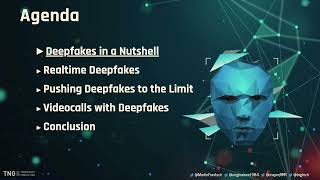 58mPushing Deepfakes to the Limit-Fake video calls with AI
 30mAI-Generated Synthetic Media, aka Deepfakes and its impact
 39mBeyond Recognition: A Cautionary Tale of AI and Identity Fraud
 01h 04mPushing Deepfakes to The Limit - Fake Video Calls With AI
 27mIs now the time to solve the deepfake threat?
 16mThe Threat of Deepfakes to Remote Identity Verification Systems
 32mHeart to Heart and Eye to Eye with Deep Fakes