Exploring User Perceptions of Discrimination in Online Targeted Advertising
summary
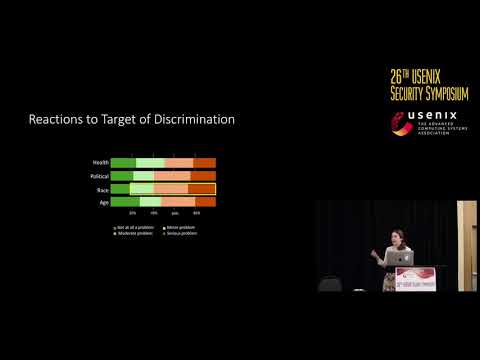
A scenario survey with a near–US‑census sample (n=2,086, final design with 24 conditions) tests reactions to discriminatory ad outcomes, fits logistic regression models, and reports that 44% are moderately or very concerned, that demographic targeting is judged worse than behavioral targeting, and that there is no human/algorithm difference in blame. Advertisers and ad buyers attract the most responsibility; results guide policy focus on targeting mechanism and accountable parties.
AI-written summary · about
chapters (15)
- 0:00Start
- 5:30Methodology
- 6:57Reactions to Target of Discrimination
- 7:31Trends: Behavior vs. Demographic
- 7:48Trends: Human vs. Algorithm
- 8:08Final Conditions
- 8:36Final Questions
- 9:05Believability
- 10:23Do you think it's a problem...?
- 11:12When is it more or less of a problem?
- 12:05How responsible is each entity?
- 13:44When is the website more or less responsible?
- 13:58When is the end user more or less responsible?
- 14:34How ethical is the behavior of each entity?
- 15:48What Did We Just Talk About?
related talks
 01h 05mSocietal Concerns in Targeted Advertising
 05mDeciding on Personalized Ads: Nudging Developers About User Privacy
 01h 07mThe great data race ...
 12mWhy am I seeing this: Democratizing End User Auditing for Online Content Recommendations
 32mPlatform-supported Auditing Of Social Media Algorithms For Public Interest
 01h 40mTHE END OF ONLINE BEHAVIOURAL ADVERTISING
 01h 07mPolitical behavioural targeting
 25mUnveiling and Quantifying Facebook Exploitation of Sensitive Personal Data for Advertising Purposes