SOPHIA: Online Reconfiguration of Clustered NoSQL Databases for Time-Varying Workloads
Talkat USENIX ATC '19 · on Wednesday, 2019-07-10· at 15:20· USENIX ATC Track II: Grand Ballroom VII–IX·
summary
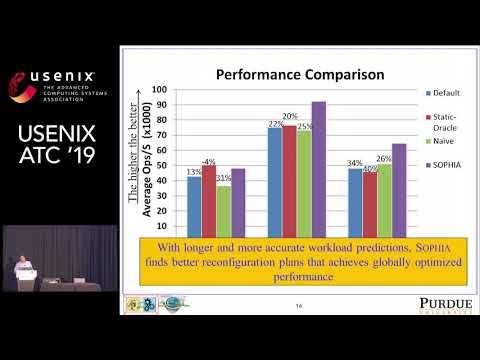
SOPHIA automatically plans online NoSQL reconfigurations by combining a Rafiki static tuner to pick impactful parameters, a first-order Markov predictor for short look-aheads (MG-RAST ~5 minutes, Tiramisu hours), and a cost‑benefit optimizer using genetic search that models restart downtime and sync time. It picks which nodes to restart via a minimum-availability subset and toggles Redis virtual memory at runtime. Evaluation on Cassandra and Redis across three workloads shows about 25–30% improvement over a naive per-phase tuner while respecting availability and consistency.
AI-written summary · about
chapters (8)
- 0:00Start
- 0:31Online NoSQL Tuning Challenges
- 2:28Look before you leap change
- 3:38Limitations of Prior Work
- 4:15Solution Overview: SOPHIA
- 6:46Distributed Online Reconfiguration Protocol
- 8:04Use Cases and Evaluation
- 11:07Evaluation: Redis
related talks
 22mOPTIMUSCLOUD: Heterogeneous Configuration Optimization for Distributed Databases
 20mSymbiosis: The Art of Application and Kernel Cache Cooperation
 34mData Storage: NoSQL Toasters and a Cloud of Kitchen Sinks
 32mHPC Multi-Cluster Database Deployment: Service Level and Availability Driven Refactoring
 18mBuilding a Scalable, Resilient System for Real-Time Fraud Detection
 46mEdge Performance with In memory NoSQL
 38mAlternatives to Redis while not compromising on its speed
 11mDatabase Evolution: Partitioning and Indexing