Debiasing Random Forests For Treatment Effect Estimation

summary
Random forests used as CATE base learners have systematic shrinkage from feature subsampling that biases subgroup effects; a simple deployable fix runs the forest, enforces out-of-bag honesty, then regresses Y on the forest predictions with a final leave-one-out OLS adjustment. In simulations and a 120k-control / 30k-treated GOTV study the correction moves a biased 1.0% ATE up to ~2.0% (truth 1.8%), tightens intervals versus conformal, and brings coverage much closer to nominal.
AI-written summary · about
chapters (13)
- 0:00Introduction
- 4:16Treatment Effect Estimation
- 9:56Resource Allocation Tradeoffs in Election Campaign Planning
- 11:16Conditional Average Treatment Effect (CATE)
- 15:01Estimators for the CATE
- 18:11Random Forests for Causal Estimation
- 19:09Bias in Random Forests
- 28:27Empirical CATE Coverage Simulations
- 30:20Data Inspired CATE Coverage Simulations
- 35:46Resource Allocation Tradeoffs in GOTV Experiments
- 38:07Theoretical Results
- 40:16Summary
- 41:10Software
related talks
 38mHow to Enhance Customer Targeting in Marketing
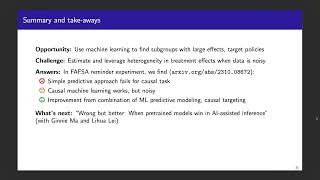 34mMachine Learning Who to Nudge: Causal vs Predictive Targeting in a Field Experiment on Student...
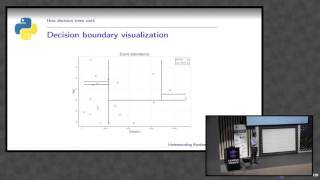 44mUnderstanding Random Forests
 36mAdventures in scikit-learn's Random Forest
 33mQuantifying uncertainty in machine learning models
 37mSelection bias: The elephant in the room
 39mCausal Effect Estimation in Practice: Lessons Learned from E-commerce & Banking
 57mFrom Bonsais to Random Forests