How to Enhance Customer Targeting in Marketing

summary
Shows concrete claims and code: uses CausalML with an XGBoost T‑learner and an uplift random forest demo to estimate effects, finding treatment conversion 0.31% vs control 0.19% and an estimated ATE ≈ 0.1% (lower than naive subtraction). Presents evaluation with AUUC/uplift curves and a result where targeting 20% of users → 80% of total uplift. Links to reproducible code and datasets accompany the walkthrough (CausalML demo).
AI-written summary · about
chapters (11)
- 0:00Causal inference in marketing
- 1:46Why causal inference matters
- 3:57Causal inference challenges
- 7:16When randomized control trials aren't possible
- 10:30ML for causal inference
- 13:01Treatment effects with metalearners
- 17:32S learner and T learner
- 21:11Uplift modeling for targeting
- 24:46Traditional vs uplift trees
- 29:25Code walkthrough with CausalML
- 36:25Summary
related talks
 43mBeyond Just Prediction: Causal Thinking in Machine Learning
 32mWhy start using uplift models for more efficient marketing campaigns
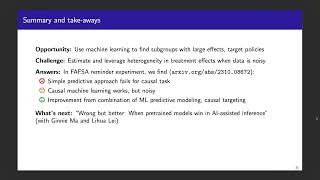 34mMachine Learning Who to Nudge: Causal vs Predictive Targeting in a Field Experiment on Student...
 13mOptimizing Subscription Services with Uplift Modeling
 39mCausal Effect Estimation in Practice: Lessons Learned from E-commerce & Banking
 19mUnveiling the Potential: Exploring Upselling, pLTV, and ML for Operations
 27mPreventing churn like a bandit
 30mPredictive Analytics in Social Media and Online Display Advertising