Machine Learning Who to Nudge: Causal vs Predictive Targeting in a Field Experiment on Student...
Talkat Bridging Prediction and Intervention Problems in Social Systems (Simons Institute, 2026) · 2026-01-12..01-18·
summary
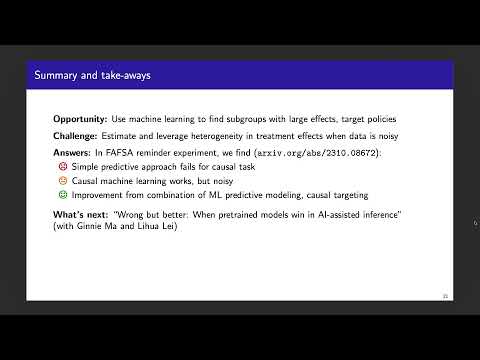
Field experiment on 25,000 CUNY students uses randomized texts to raise FAFSA renewals and finds a 6.4 percentage-point average boost from 37% baseline. Causal forests for CATEs identify noisy heterogeneity (estimated range ~0–15 points) that yields weak targeting gains, while a hybrid approach—machine-learning baseline + simple logistic choice model—delivers much stronger results, reaching about 75% of the benefit from targeting half the students and outperforming pure predictive targeting and pure causal forest methods.
AI-written summary · about
chapters (15)
- 0:00Introduction
- 1:04Heterogeneous treatment effects motivation
- 3:17Challenges in small trials
- 5:30Foundational methods overview
- 8:30Study context and intervention
- 10:21Baseline analysis and ATE
- 12:31Methodology for CATE estimation
- 15:46Evaluating targeting policies
- 18:24Counterfactual econometric approach
- 21:45Causal ML targeting results
- 22:53Predictive targeting without causals
- 24:07Hybrid prediction-causal approach
- 27:26Key insights and interpretation
- 30:26Broader implications recap
- 31:32Q&A
related talks
 38mHow to Enhance Customer Targeting in Marketing
 43mBeyond Just Prediction: Causal Thinking in Machine Learning
 39mCausal Effect Estimation in Practice: Lessons Learned from E-commerce & Banking
 54mDebiasing Random Forests For Treatment Effect Estimation
 25mMachine learning algorithms as tools for student success prediction
 41mKeynote: Personalization, Bandits, and Causal inference
 13mOptimizing Subscription Services with Uplift Modeling
 32mWhy start using uplift models for more efficient marketing campaigns