Global Community Detection Using Individual-Centered Partial Information Networks

summary
Framework models an L=2 partial-view as a partial adjacency B = S A S and isolates a random signal term BE whose rank is 2K under SBM/DCSBM; eigenvalues and eigenvectors of BE are derived and drive new spectral algorithms that prove weak consistency when local edge density PN exceeds specified bounds. A proposed eigengap centrality (lambda_min) predicts which centers recover global communities; simulations show ~0.7 correlation with per-node accuracy versus standard centralities, and application to 39 Indian villages links leader centrality to program participation.
AI-written summary · about
chapters (14)
- 0:00Intro
- 1:16Social network modeling
- 3:30How much does a person understand about the connections in the full network?
- 4:28A toy example of individual-centered partial information networks
- 6:35Existing literature
- 9:53A peak at the results
- 12:20Preliminaries - low rank assumption
- 14:02Theoretical properties of B
- 23:04Main algorithm for SBM
- 25:57Main algorithm for DCSBM
- 26:43A conditional setting emphasizing individual differences
- 31:54Simulation with DCSBM
- 37:10Summary and future work
- 38:48External impact of statistical theory and methodology papers
related talks
 35mLocal Statistics, Semidefinite Programming, and Community Detection II
 43mInformation-Theoretic Bounds and Phase Transitions in Community Detection and High-Dimensional Clust
 45mCommunity Detection with the Non-Backtracking Operator
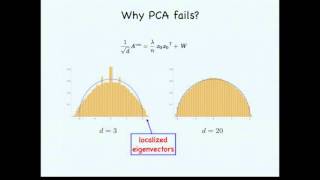 47mPhase Transitions in Semidefinite Relaxations (A Fast & Robust Algorithm for Community Detection)
 32mLocal Statistics, Semidefinite Programming, and Community Detection
 47mLearning Probabilistic Models for Graph Partitioning in the Presence of Noise
 25mFundamental Limit of Community Detection in Stochastic Block Models
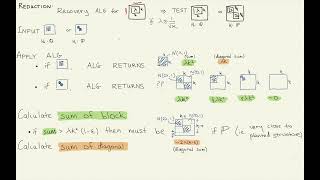 24mIs it easier to count communities than find them?