Community Detection with the Non-Backtracking Operator
summary
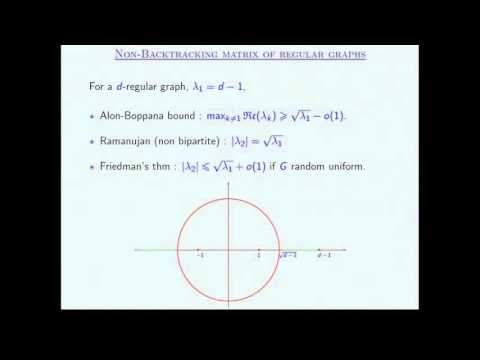
Shows that the non-backtracking operator (the edge-to-edge B matrix) produces an eigenvalue outside the bulk for sparse random graphs when the signal-to-noise ratio crosses the sharp detectability threshold (roughly when the relevant eigenvalue exceeds 1), gives a practical algorithm that computes the leading eigenvector on directed edges and projects it to vertices, and proves this outperforms adjacency-based spectral methods on stochastic block models; demonstrates performance on real data like the Karate-club dataset and handles extremely sparse regimes.
AI-written summary · about
chapters (8)
- 0:00Introduction
- 6:31Directed and undirected graphs
- 13:52Spectral properties and gap
- 20:19Galton-Watson process and applications
- 27:08Community detection with non-backtracking
- 34:19Comparison with classical spectral methods
- 40:56Stochastic models: limits and cases
- 44:13Conclusion
related talks
 35mLocal Statistics, Semidefinite Programming, and Community Detection II
 43mGlobal Community Detection Using Individual-Centered Partial Information Networks
 29mApplying Randomized Methods for Zonotope Enumeration and...
 56mGraph Matching: Relax or Not?
 11mUnderstanding Statistical-to-Computational Gaps via Low-Degree Polynomials
 39mLocal Algorithms for Community Detection
 45mRandom Walks on Directed Graphs
 01h 02mGraph Powering