"Disorganizing" Your SRE Organization
summary
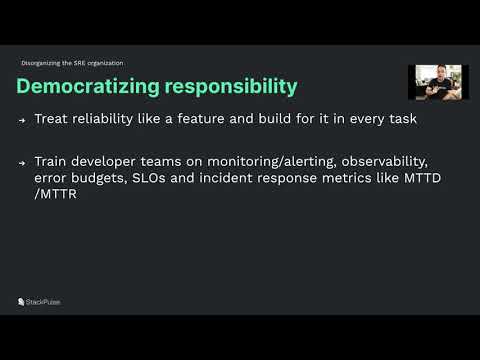
After COVID forces remote work the SRE role is democratized across engineers and managers, with reliability treated as a feature and on-call responsibility distributed. Operations are encoded as code-based incident response playbooks in a YAML DSL, each step run in Docker modules for deterministic enrichment, triage, communication and remediation. Results: over 60% of incident enrichment automated, mean time to resolve falls ~35%, and more than half of team members lead real incidents.
AI-written summary · about
chapters (11)
- 0:00Intro
- 0:44What I'm going to talk about today 1. The impacts of WFH on the teams responsible for reliability
- 1:30What were our challenges? The agility and innovation in how we build and ship software has increased velocity and fragmented knowledge
- 6:11Our Journey: Biggest Challenges + Training / Onboarding team members in a growing team
- 11:44Democratizing responsibility
- 14:25Empowering Autonomy and consistency - Why
- 20:16What does "turn into code" look like for us?
- 24:14Our Journey: Getting Started 1 Month: On-call and playbook writing spread across developers
- 28:47Build to individual need People have different preferences for interruptions, privacy. communication style
- 30:06Explictly build a new culture - Directly share that you're working on culture as a project
- 31:35Terminate loops locally - Re-divide responsibilities
related talks
 45m“Disorganizing” Your SRE Organization
 26mFrom Nothing to SRE: Practical Guidance on Implementing SRE in Smaller Organisations
 35mThe Best SREs Seem to Be the Ones without an SRE Title—And What We Can Do
 07mIGNITE: Metrics, Margins, Mutiny – How to make your SREs (not) run away
 31mConfessions of an SRE Manager
 18mDeploying Humans at the Edge of SRE
 45mClearing the Way for SRE in the Enterprise
 24mBeing Reasonable about SRE