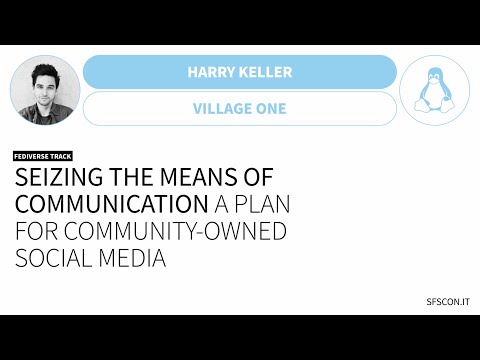
Seizing the means of communication — a plan for community-owned social media
summary
Argues that community-owned Mastodon and Fediverse instances already exist (examples: co-social.ca, social.coop, data.coop), classifies instances as flagship, indie, or self-hosted, and claims cooperative instances give users real governance via one member one vote and cooperative funding built in. Notes concrete tradeoffs: flagship stability vs. centralization, indie fragility (Mozilla shut an instance; a large German instance was rescued by takeover), and self-hosting difficulty. Proposes recruiting new users through local co-ops and physical spaces using Mastodon, PixelFed, Matrix and code forges.
AI-written summary · about
chapters (6)
- 0:00Introduction and title
- 1:12Fediverse as community-driven media
- 5:25What is a cooperative?
- 7:50Social media cooperatives
- 10:57Expanding beyond existing users
- 13:22Q&A and closing remarks
related talks
 29mAdapting to the New Era of Social Platforms in Open Source
 19mBuild Better Webs
 38mWhy Open Source and Web3 need to find (back) together
 18mExit to Your Community
 28mBuilding Open Source Communities
 17mScaling Community, Code, Contributors
 18mExploring the Intersection Between OSS and Exit to Community
 12mGemeinschaft and Gesellschaft - A Model for Non-profits and Open Source Projects