Making Money Disappear with Hash Functions!
summary
Python code is used to generate addresses from random 256‑bit keys and to query blockchain.info’s API; mass querying triggers denial‑of‑service blocking. Malformed-address patterns actually hold real value: about $32,000 in that account for an all‑zero address and about $1,600 for a point off the curve. The talk demonstrates ECDSA on curve y^2 = x^3 + 7 and the RIPEMD160(SHA256(public key)) step, showing how hashing compresses addresses but also creates permanent, unspendable black‑hole funds.
AI-written summary · about
chapters (11)
- 0:00Making Money Disappear with Hash Functions!
- 0:33What is a Bitcoin Address?
- 0:49What is Bitcoin?
- 1:18Two Problems to Solve
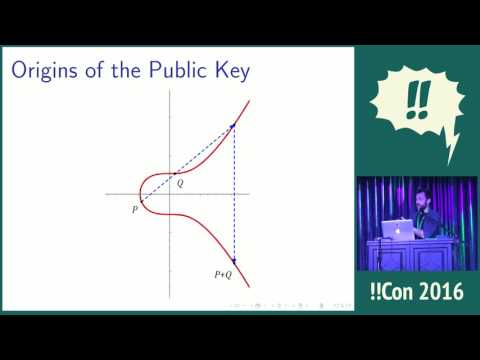
- 3:31Origins of the Public Key
- 4:45Generating a Public Key
- 5:47Elliptic Curve Signatures
- 7:02Cryptographic Hashes
- 8:15Counting Money in the Void!
- 10:25The Hashing Debate
- 11:59References
related talks
 53mDissecting Bitcoin Security
 40mBlockchain Security Guarantees and Exploits
 49mAttacking and Defending Blockchains: From Horror Stories to Secure Wallets
 24mHow Did the Adversaries Abusing the Bitcoin Blockchain Evade Our Takeover?
 44mCryptography Pitfalls
 43mExtracting knowledge from cryptocurrencies
 17mThe Hidden Danger in Financial Transactions
 52mMore Secrets of Cryptography