Implementing the LHC on a Whiteboard
summary
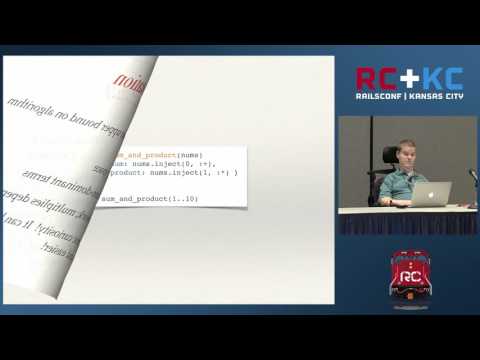
Argument: algorithmic thinking beats jargon; Big O helps find simpler solutions. Demonstrations use Ruby: hash-based linear set intersection, recursive Fibonacci, memoization and dynamic programming, with Minitest benchmark showing naive recursion overwhelms Ruby while DP runs fine. Practical rules: follow directions (use git if asked), read and clarify requirements, implement the core algorithm and test it first, avoid heavy dependencies or bonus features, submit on time then polish offline. A puzzle (nine balls, two weighings) illustrates divide-and-conquer reasoning.
AI-written summary · about
chapters (34)
- 0:00Introduction
- 2:26No Red Ink
- 2:46Tips
- 3:07caveats
- 4:42suicide
- 4:59study
- 5:25most useful concepts
- 6:10Big O notation
- 6:59Big O notation gets a bad rap
- 7:22Big O notation quiz
- 8:57Hybrid sort
- 10:24Interviewing problem
- 10:44Brute force approach
- 11:32Linear approach
- 12:09Linear solution
- 12:52Minitest
- 13:49Minitest Benchmark
- 15:00Brain Teaser
- 16:31Exorcism Bio
- 17:24Programming Interview Problems
- 17:54Open Source
- 19:01Goals
- 19:51Read Carefully
- 21:14Pop Quiz
- 22:37Stop and Think
- 23:11Funny Tweet
- 23:21Think Out Loud
- 26:47Dont Write
- 28:40Test Case
- 29:32Avoid dependencies
- 31:16Ignore bonus challenges
- 32:26Time limits
- 33:40Text editing skills
- 34:47Conclusion
related talks
 49mMy Dog Taught Me to Code
 58mKeynote: (Parenthetically Speaking)
 40mWorkshop - Simplifying Code: Monster to Elegant in Less Than 5 steps
 07mUnconference pitches
 31mAn Optimistic Proposal for Making Horrible Code... Bearable
 28mHarry Potter and the Legacy Codebase
 25mMX Hacker's Revenge
 37mThis or that? Similar methods & classes in Ruby && Rails