Deciphering Sales Drivers at PepsiCo

summary
Compares Bayesian and Frequentist regressions applied to Media Mix Modeling, using lightweightMMM JAX NumPyro to fit nonlinear ad-response curves, priors derived from Amazon Marketing Cloud (notably 90% convert within seven days), and a production pipeline with outlier detection and feature-scaling safeguards. Claims model predicts sales with about 3% average prediction error, decomposes attributed (8.48) versus incremental (2.60) return on ad spend, finds >70% of reported attribution is organic, and documents remaining gaps that motivate simulation and iterative validation.
AI-written summary · about
chapters (15)
- 0:00PepsiCo e-commerce analytics intro
- 2:19Marketing investment impact
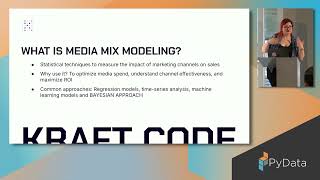
- 4:47Marketing Mix Modeling
- 7:32Modeling approach comparison
- 10:01Frequentist vs Bayesian regression
- 13:39Building Bayesian MMM model
- 16:08Attributed vs incremental sales
- 17:37ROI and sales optimization
- 18:41Year-to-year growth
- 20:09Model deployment challenges
- 22:37Feature engineering for explainability
- 24:04Handling multicollinearity
- 25:29Hyperparameter tuning
- 26:34Key takeaways
- 27:39Future directions
related talks
 29mMedia Mix Modelling
 31mMedia Mix Modeling:How to Measure the Effectiveness of Advertising
 39mHow to Allocate Marketing Budget - Bayesian Approach to the Rescue
 30mIs your marketing effective? Let Bayes decide!
 01h 26mProbabilistic Programming and Bayesian Computing with PyMC
 27mAI and analytics for better marketing performance
 42mSolving Real-World Business Problems with Bayesian Modeling
 30mPredictive Analytics in Social Media and Online Display Advertising