The Beauty and the Beast: Python on GPUS
summary
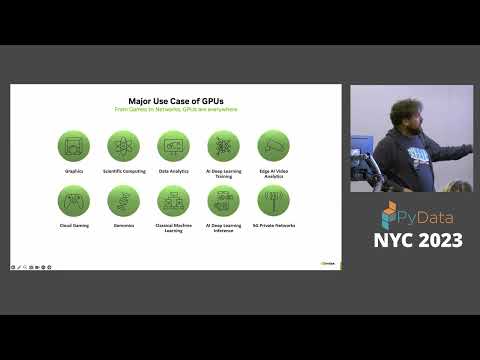
Python code runs correctly on GPUs only when it handles memory and threading explicitly or uses tooling that does it for you: low‑level CUDA and CUDA Python expose PTX and registers, array libraries like cuPy and compiler tooling like OpenAI Triton or PyTorch compile JIT work around that, and data stacks like RAPIDS put dataframes and XGBoost on the card. GPUs run thousands of threads (CPUs ~8–32) and transformers show ~6× speedups when tensor cores and streaming are used.
AI-written summary · about
chapters (13)
- 0:00Python on GPUs intro
- 1:12GPU hardware and SIMT
- 8:45Why GPUs for parallel
- 9:50Python’s GPU journey
- 13:04GPU computing libraries
- 15:15Automated GPU systems
- 18:29Writing GPU kernels
- 22:44GPU and Python recap
- 23:27Q&A on GPU programming and memory management
- 26:02Beginner GPU tools
- 27:27CUDA backwards compat
- 30:41Python on GPUs future
- 34:34JIT vs CUDA kernels
related talks
 33mWhen GPUs Make Python Slower: Patterns and Pitfalls
 01h 02mExploit your GPU power with PyCUDA (and friends)
 41mLuxuries, necessities, and the challenges that remain
 02h 28mGPU Accelerated Python
 02h 14mGPU development in Python 101
 29mA Beginners Guide to GPUs for Pythonistas
 30mCUDA in Your Python: Effective Parallel Programming on the GPU
 35mCUDA in Python- A New Era for GPU Acceleration