Open Source Computational Economics: The State of the Art
summary
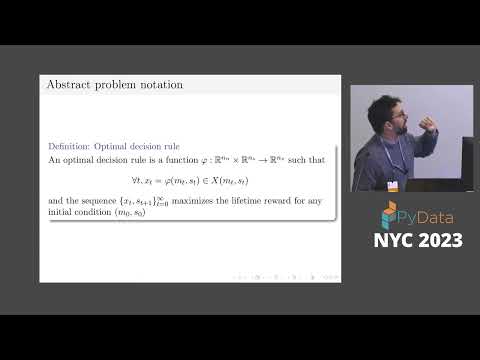
Open source toolkits like diner, Doo and Quant Eon provide model DSLs and solvers but struggle with high dimensional heterogeneous agent models so recent papers use deep learning surrogate models and a pseudo-state trick to sample trajectories via Monte Carlo and train neural policies. The claim is that encoding Euler equations into a neural objective defeats the curse of dimensionality, estimation becomes one shot, and empirical results report surprisingly accurate policy functions and fast calibration compared with grid methods.
AI-written summary · about
chapters (7)
- 0:00Open source computational economics
- 2:58DSGE to heterogeneous agents
- 7:50Dynamic programming in modeling
- 11:43Software for heterogeneous agents
- 15:23Deep learning in macroeconomics
- 23:02Parameter estimation with deep learning
- 30:35Future of open source tools
related talks
 44mOpen-Source and Science in the Era of Foundation Models
 27mKeynote: Open Source in the Age of AI
 13mKeynote: To Nemotron and Beyond: Building the Open Source AI Ecosystem
 20mOwn your agent
 11mKeynote: Open Source Stack Empowers the AI Era
 17mOpen Innovation: Unlocking AI's Potential
 23mOpenROAD and the Era of Agents
 31mThe AI Revolution Will Not Be Monopolized: How open-source beats economies of scale, even for LLMs