Statistically Solving Sneezes and Sniffles Step by Step
summary
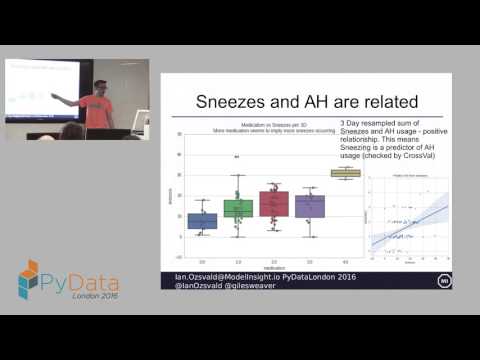
Project records a year of one-person, timestamped symptom logs with GPS and backs them up to Segment IO, plus external London Air, weather, MyFitnessPal and Oyster-scraped commute data. An open-source iOS app and data prep tools get built. Models (logistic regression, random forests, SVMs, recursive feature elimination; scikit-learn, statsmodels) train on ~330 rows and 84 engineered features and expose overfitting. Key findings: loratadine shows ~2h onset and ~9h effective window and low humidity correlates with more sneezes; pollution shows no clear signal yet.
AI-written summary · about
chapters (7)
- 0:00Introduction
- 2:53Sneezing patterns
- 6:45iOS app for data
- 17:15Data relationships
- 22:19Predictive models
- 29:35Next steps
- 31:19Q&A
related talks
 27mHARSHA URLAM & SWETA SINGH at Cypher 2017
 06mPredicting Subjective Measures of Social Anxiety from Sparsely Collected Mobile Sensor Data
 26mMachine Learning for Personalised Health
 01h 00mTake Control of the Data of You
 01h 04mTake Control of the Data of You
 22mCOVID-19: Data Science & Expertise
 44mQuantified Self: Analyzing the Big Data of our Daily Life
 42mMachine learning with ventilator data