Probablistic Programming Data Science with PyMC3

summary
Overview of concrete claims and results: PyMC3 with Theano implements Bayesian models and runs MCMC (NUTS) and variational inference (ADVI) to automate inference; applied to a trading backtest that shows ~800% cumulative return in-sample, a tiny 20-day out-of-sample window, and a computed 3.34% probability that the in‑sample mean is below the out‑of‑sample mean, flagging likely overfit. A Bayesian neural network demo reaches ~95.4% accuracy; sampling (10k draws) runs in seconds and ADVI mini‑batches scale to large data. The platform later deploys $100,000 to the strategy and it underperforms.
AI-written summary · about
chapters (17)
- 0:00Introduction to probabilistic programming
- 1:11Why probabilistic programming
- 3:21Overfitting in backtests
- 5:29Distribution testing approaches
- 8:38White box solution for modeling
- 10:02Generative models for inference
- 11:26Modeling stock returns with PyMC3
- 16:19Automating inference with MCMC
- 19:29Overfitting consequences
- 23:21Bayesian neural network in PyMC3
- 26:52Predictions with uncertainty
- 29:27Probabilistic programming in ML
- 29:50Faster inference with variational
- 31:54Scaling with mini-batch variational
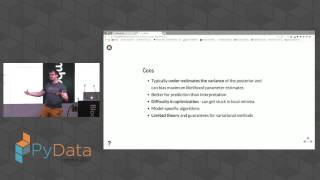
- 33:18Key advantages
- 34:25Learning PyMC3 resources
- 37:40Q&A on variational inference
related talks
 01h 31mProbabilistic Programming and Bayesian Inference in Python
 35mVariational Inference and Python
 44mAn introduction to PyMC3
 57mA Quickstart Guide to PyMC3
 01h 26mProbabilistic Programming and Bayesian Computing with PyMC
 01h 27mProbabilistic Python: An Introduction to Bayesian Modeling with PyMC
 42mSolving Real-World Business Problems with Bayesian Modeling
 42mBayesian Non-parametric Models for Data Science using PyMC3