Deep Learning for QSAR
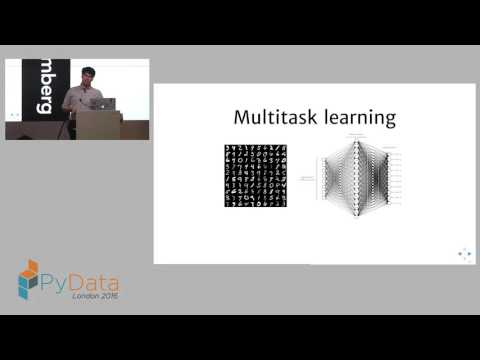
summary
Claims that deep learning is state of the art for QSAR and cites Kaggle Merck and Tox21 wins and then shows a reproducible pipeline: data pulled with sqlalchemy and pandas, features extracted with RDKit as circular (Morgan) fingerprints, models trained with Theano and Keras using batch normalization, Adam and L1 regularization. Dataset is ~250k compounds, ~500k activities across ~710 proteins with <1% density; uses multitask outputs, implements sparse multitask masking for regression, outperforms logistic regression, predicts caffeine—adenosine affinity, but overfits and hits GPU limits.
AI-written summary · about
chapters (22)
- 0:00Introduction
- 3:21What is deep learning
- 7:46Deep learning for QSAR
- 10:19Feature learning in molecules
- 12:14QSAR data challenges
- 15:52Cleaning sparse QSAR datasets
- 17:41Circular fingerprints
- 19:07Model architecture
- 20:54Model optimization
- 22:20Training hardware struggles
- 23:24Model performance metrics
- 24:36Testing on caffeine
- 25:39Model predictions with maps
- 28:03Regression models for QSAR
- 29:27Sparse multitask regression
- 30:54Deep vs traditional methods
- 31:37Transfer learning for QSAR
- 32:43Answering audience questions on model layers
- 35:05Feature representations evolution
- 36:19Active learning strategies
- 37:44Chemical structures in 2D
- 39:08Future directions
related talks
 37mRecent Solutions Using Deep Learning Models/ The How and Why
 55mGPU-accelerated virtual drug screening
 32mQuantum Artificial Intelligence
 30mLeveraging Molecular Data for Drug Discovery
 37mDeep Recommender Systems
 16mBeyond Patterns: The Case for Physics-Grounded AI in Drug Discovery
 30mMachine Learning: A New Approach to Drug Discovery
 30mAI in Drug Discovery