Composable AI: Building Next-Gen AI Agents with MCP
summary
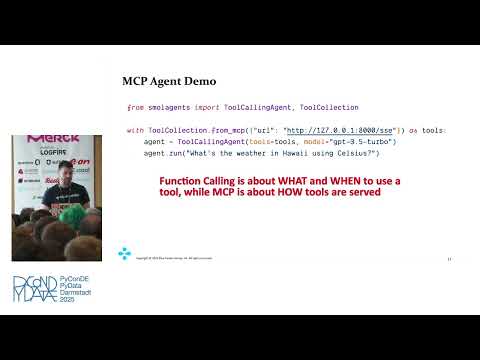
Explains how the Model Context Protocol (MCP) turns APIs into reusable tool servers so agents call tools (via function calling) instead of custom integrations, using MCP servers for Postgres, Snowflake, Slack, browser and VS Code, standard transports like stdio and SSE (HTTP streaming coming), and authentication by forwarding bearer tokens. Claims thousands of MCP servers exist, that 50–100 tools is the practical sweet spot, and gives a real example: a social manager product built from 29 MCP servers that runs in production and charges users.
AI-written summary · about
chapters (8)
- 0:00Composable AI and MCP
- 2:38AI agent definition and tools
- 7:15Need for MCP and how it works
- 11:54Building MCP servers and AI
- 15:06Reusing APIs with MCP
- 17:59Scaling agents with tools
- 21:10Agent protocol and future standards
- 23:22Q&A on MCP
related talks
 33mThe Model Context Protocol: Connecting AI to Everything
 37mLetting AI Interface with Your App with MCPs
 36mPutting AI Agents to Work: A New Era of Open Source Connectivity with MCP
 46mMCP for LLM Agents, Infrastructure APIs & Data Services
 29mEmpowering Your Product with Agentic AI
 50mBeyond local tools: Dive into the Model Context Protocol (MCP)
 35mMCP in Action: Real-World Use Cases & Design Patterns
 42mMCP in Practice: One App to Understand It All