Benchmarking Time Series Foundation Models with sktime
summary
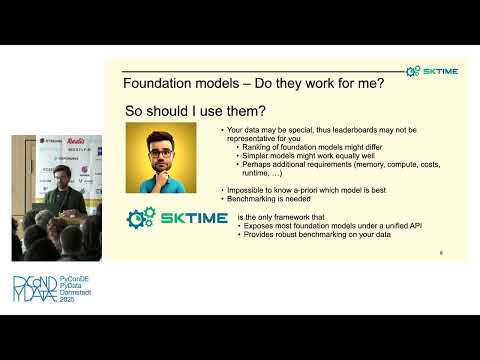
sktime exposes multiple time series foundation models (Morai, Tiny Times Mixer, Kronos, TimesFM, TimeMOE, MomentFM, etc.) behind a unified API and a benchmarking pipeline that uses an instance splitter, a global temporal splitter, and temporal CV, exports JSON checkpoints and records MSE/RMSE/MAE and runtime (log scale). On Australian half‑hourly electricity (five states) Kronos outperforms Morai; Morai shows large daytime errors, while a default N‑BEATS baseline competes with or exceeds some foundation models. Fine‑tuning is not yet supported; context/horizon limits require head retraining.
AI-written summary · about
chapters (13)
- 0:00sKtime and foundation models
- 2:15Beyond toolbox features
- 3:38Foundation models for forecasting
- 5:28Advantages and limitations
- 7:14Requirements for robust benchmarks
- 9:25Energy demand forecasting
- 12:19Cross-validation strategies
- 14:47Forecast errors by horizon
- 15:53Runtime performance
- 16:15Hierarchical forecasting
- 17:19sKtime benchmarking state
- 18:24Getting started with sKtime
- 19:30Q&A
related talks
 30msktime: python toolbox for time series- next-generation AI
 32mAdopting Open-Source Tools for Time Series Forecasting
 26mTime Series Analysis in Python: Easy Tools for Scientific Insight
 21mFoundational Models for Time Series Forecasting: are we there yet?
 01h 26mSktime—Python Toolbox for Time Series: How to Implement Your Own Estimator
 30mFoundational Models for Time Series Forecasting: are we there yet
 33mBacktesting and error metrics for modern time series forecasting
 31mFoundational Time Series Models in Practice: The Future of Forecasting, or Just Hype?