Empowering Your Product with Agentic AI

summary
Model Context Protocol (MCP) is a standard that lets LLMs discover and call real tools and data sources — demo shows Claude Desktop connected to Slack and ClickUp MCP servers, asked to summarize the latest 10 Slack messages (including threads) and automatically create prioritized ClickUp tasks with summaries and Slack URLs, which succeeds. MCP exposes resources, prompts, and tools, supports deterministic helpers for math, offers SDKs in TypeScript/Python/Java/.NET/Swift/Kotlin, and ships a Docker toolkit with ~50 MCP servers to flip on for rapid integration of agentic behavior.
AI-written summary · about
chapters (14)
- 0:00Introduction and speaker welcome
- 1:11Context is king in AI
- 3:00From monoliths to agentic AI
- 4:44Model Context Protocol explained
- 6:53Live demo of MCP in action
- 9:02How MCP enables agentic behavior
- 12:33MCP resources, prompts and tools
- 16:05Tools for deterministic and complex tasks
- 18:36MCP for product interoperability
- 20:21Integrating MCP into your platform
- 21:26Tips for MCP server and client integration
- 22:51Monetizing MCP and API strategies
- 24:39Bottom line and closing remarks
- 25:02Q&A session
related talks
 33mThe Model Context Protocol: Connecting AI to Everything
 30mComposable AI: Building Next-Gen AI Agents with MCP
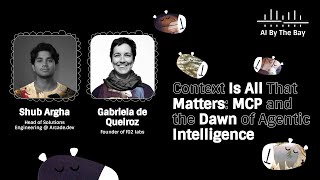 12mMCP and the Dawn of Agentic Intelligence
 37mLetting AI Interface with Your App with MCPs
 46mMCP for LLM Agents, Infrastructure APIs & Data Services
 35mMCP in Action: Real-World Use Cases & Design Patterns
 44mBeyond the Prompt: How MCP Connects Language Models to Real Tools
 50mBeyond local tools: Dive into the Model Context Protocol (MCP)