PANEL: Statistical Theory, Privacy and Data Analysis

summary
Panel argues that differential privacy acts as both a constraint and an enabler: it enforces data hygiene, gives formal generalization guarantees, and opens new data sources, but introduces extra uncertainty and a hard epsilon calibration problem with no settled procedure. Practical fixes discussed include using sampling/subsampling for provable amplification, publishing code to trusted third parties or repositories, building DP-aware analysis shells (e.g., PINK-style interfaces), and reporting perturbation intervals instead of unwarranted model-based p-values.
AI-written summary · about
chapters (14)
- 0:00Panel introduction
- 2:38Defining data science
- 4:41Science vs. engineering
- 7:29The iterative data lifecycle
- 9:41Debating AI and hype
- 13:03Rigor in statistical practice
- 15:48Bridging theory and reality
- 18:54Differential privacy trade-offs
- 23:12Privacy in industrial contexts
- 25:02Medical data and privacy
- 28:20Asymptotics and randomization
- 36:50Exploratory data analysis
- 42:22Reproducibility challenges
- 51:22Uncertainty and closing thoughts
related talks
 01h 07mStatistical Inference and Privacy, Part I
 19mPractical Considerations for Differential Privacy
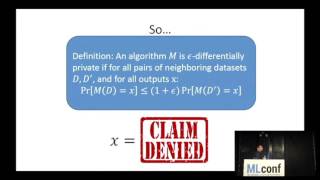 26mAaron Roth, Associate Professor, University of Pennsylvania, NYC 2017
 43mPanel: Privacy Design Patterns for AI Systems: Threats and Protections
 01h 14mTutorial: Privacy, Part II
 01h 05mMarkets and Incentives for Transacting on (Personal) Information, Part III
 20mShare data without revealing personal information
 01h 03mStatistical Inference and Privacy, Part II