Aaron Roth, Associate Professor, University of Pennsylvania, NYC 2017
summary
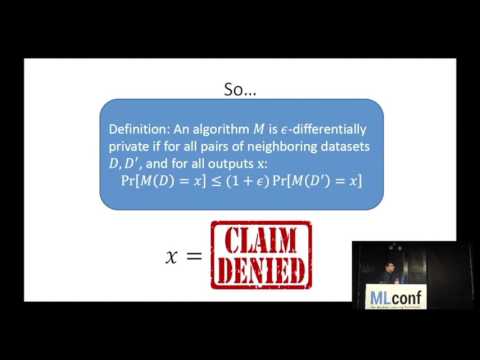
Shows that concrete privacy failures (AOL, Netflix, genomic reidentification) motivate differential privacy, a formal guarantee where randomized algorithms hide any single record. Builds and analyzes primitives: Laplace mechanism for numeric answers, exponential mechanism for categorical choices, Gaussian perturbation of regression estimates, and noisy-SGD for deep nets. Proves DP composes and prevents overfitting by at most ε, and demonstrates empirically on 20,000 rows 10,000 dimensions that a DP holdout resists repeated reuse and recovers true signals.
AI-written summary · about
chapters (7)
- 0:00Start
- 0:26Protecting Privacy is Important
- 5:19So What is Differential Privacy?
- 13:48Answering Non-numeric Queries
- 19:23Private Stochastic Gradient Descent
- 22:22Reusable holdout example
- 23:22Classification after feature selection
related talks
 19mPractical Considerations for Differential Privacy
 01h 00mPANEL: Statistical Theory, Privacy and Data Analysis
 01h 14mTutorial: Privacy, Part II
 42mDifferential Privacy
 35mDifferential Privacy Made Practical
 58mLarge-Scale Private Learning, Part III
 21m"SECRETS ARE LIES, SHARING IS CARING, PRIVACY IS THEFT." - A Dive into Privacy Preserving
 50mPrivacy Amplification by Sampling and Renyi Differential Privacy