Practical Insights from Following NIST SP 1800-38B
summary
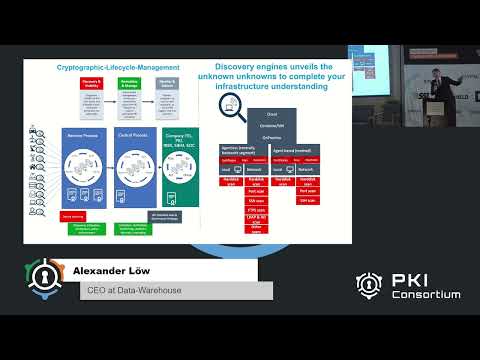
Real-world implementation follows NIST SP 1800-38B by building a continuous cryptographic inventory fed by agent and agentless discovery, SBOM/CBOM exports and certificate transparency feeds, then prioritizing remediation. Scans reveal surprising scale — about 250,000 certificates on a single MacBook and up to ~460,000 on Windows — and many keys require reclassification, roughly 30% reassessed. TPMs, embedded devices and hidden DB keys need agents or developer coordination. The inventory plus dashboards enables measurable migration and demonstrated workable cryptographic agility.
AI-written summary · about
chapters (20)
- 0:00Conference introduction
- 1:30Talk overview
- 2:36Speaker background
- 4:23NIST SP 1800-38B action blocks
- 6:53Implementing NIST recommendations
- 9:25Enterprise supply chain challenges
- 10:55Cryptographic discovery essentials
- 12:41Cryptographic lifecycle monitoring
- 14:30Cryptographic inventory example
- 15:54Certificate categorization
- 17:00Cryptography education gap
- 18:06Integrating inventory into architecture
- 19:32Key takeaways and next steps
- 20:17Legacy systems importance
- 21:00Closing remarks
- 22:12Q&A: Agent vs agentless discovery
- 24:00Q&A: Scanning keys in databases
- 26:07Q&A: Leveraging enterprise tools
- 27:53Q&A: Code as cryptographic assets
- 29:17Q&A: Quantum risk assessment
related talks
 21mCryptography at Scale: Building a Practical Cryptographic...
 12mKeyfactor on Cryptographic Discovery: Why Knowing What You Have Is Step One
 49mHerding Certs - How to Automate Certificate Management
 27mScaling Trust: CLM Roadblocks on the Path to Post Quantum Resilience
 27mCrypto Agility How it’s both a Critical Component and a Complex Challenge
 50mProtecting Machine Identities: USPTO and Certificate Automation
 30mTrust Engineering: Building Security Leadership at Early-Stage...
 30mPreparing Vulnerability Management for the Post-Quantum Era: From Legacy Cryptography Crypto-Agility