Multi-Agent Reinforcement Learning in the High Population Regime
summary
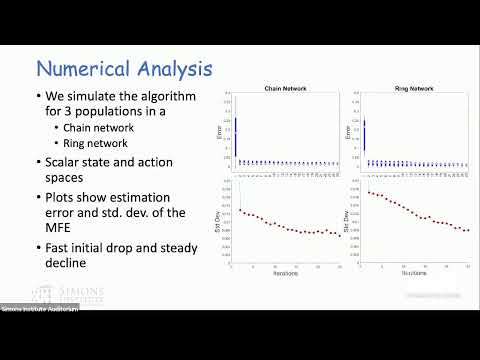
Shows that for multi‑population discrete time LQG games the mean‑field equilibrium is affine and produces an approximate Nash with error O(1/√N) where N is the smallest local population size, with existence and uniqueness proofs. Introduces a model‑free algorithm using zero‑order stochastic optimization and a two‑stage: linear then affine decomposition that learns gains and offsets via a central simulator, gives finite‑sample bounds, and simulates three populations (chain vs ring) where sparser links converge faster.
AI-written summary · about
chapters (16)
- 0:00Introduction
- 3:03Game Theory
- 5:36Finite Population Games
- 9:29Mean Field Approach
- 17:13Central Coordinator
- 20:53Consensus Game
- 26:08Multi Populations
- 33:08Proof
- 37:15Challenges
- 38:35Reinforcement Learning
- 41:29General Approach
- 42:38Simulation Error Noise
- 43:39ZSO Based RL
- 44:30ZSO Parameters
- 47:06Simulation
- 50:56Questions
related talks
 45mAGT and Machine Learning
 38mRetrospective on multi-agent learning as a path to intelligence
 41mSpotlight Talks
 01h 29mLLM Safety, Alignment, and Generalization
 53mIterative preference learning methods for large language model post training
 47mRebel: Combining Deep Reinforcement Learning and Search for Imperfect-Information Games
 30mReinforcement Learning - ChatGPT, Playing Games & More
 46mEfficient Policy Optimization Techniques for LLMs