Carpooling and the Economics of Self-Driving Cars
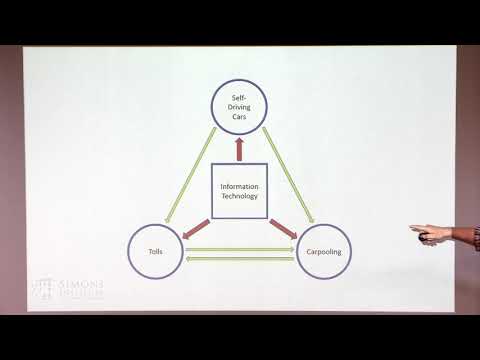
summary
Argues that combining frictionless time-dependent tolls (GPS/license-plate systems like Singapore’s 2020 rollout) with practical carpooling matching produces large welfare gains: with a simple Vickrey bottleneck example (capacity 60, demand 120) tolls alone can eliminate congestion but are politically unpopular, while modest tolls (~Delta/2) plus two-person carpools induce universal carpooling and the efficient outcome. Presents a model with trips, segment capacities, rider prices P and regulator tolls R; any feasible, stable, budget-balanced, market-clearing outcome maximizes social surplus, and a divisible approximation guarantees existence.
AI-written summary · about
chapters (12)
- 0:00Intro
- 7:50Carpooling
- 10:00Selfdriving cars
- 12:10Autonomous transportation and carpooling
- 21:40Carpooling and road pricing
- 28:30Inefficiencies
- 35:30Model
- 39:10Valuation
- 41:47Outcome
- 43:48Main Result
- 44:40Problem
- 46:03Question
related talks
 01h 38mRidesharing
 33mThe Rideshare Dispatch Problem (Aka Online Bipartite Matching with Supply Externalities)
 41mDynamic Pricing in Ride-Sharing Platforms
 01h 08mUnderstanding and Shaping Urban Mobility Using Dollars and Data I
 01h 03mUnderstanding and Shaping Urban Mobility Using Dollars and Data II
 44mComputational Complexity of Matching in Ride Sharing
 43mRebalancing in Bike-Sharing Systems – Incentives and Other Stories
 44mFacilitating the Search for Partners on Matching Platforms