Minimum Rényi Correlation Principle: From Marginals to Joint Distribution
summary
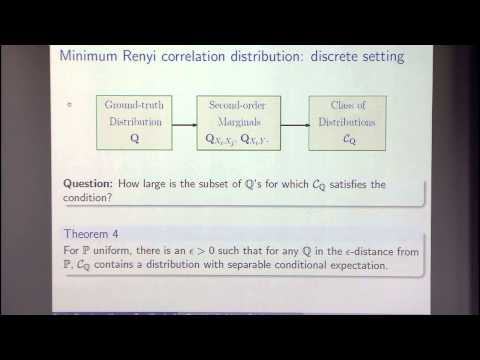
Defines a Principle of Minimum Rényi Correlation that picks a joint P agreeing with given first/second marginals by minimizing Rényi maximal correlation, proves for real vectors the joint Gaussian minimizes Rényi correlation under fixed moments, gives a discrete recipe that reduces to a quadratic program on indicator variables, proves a necessary-and-sufficient separability condition that can be checked in linear time, and shows the estimator recovers group LASSO after empirical plug‑in.
AI-written summary · about
chapters (9)
- 0:00Introduction to modeling
- 2:29Defining dependence measures
- 3:32Rényi maximal correlation
- 5:55Principle of minimum correlation
- 7:44Solving the discrete case
- 11:20Existence and theoretical bounds
- 13:26Application to variable selection
- 14:43Summary and conclusions
- 16:14Q&A and future directions
related talks
 09mConvex Programs, Computational Phase Transitions, and Robust Algorithms
 32mQuantitative Correlation Inequalities via Semigroup Interpolation
 54mExact Matching Of Random Graphs With Constant Correlation
 52mNew Algorithms For The Graph Alignment Problem
 40mTesting Correlation of Unlabeled Random Graphs
 41mReducibility and Statistical-Computational Gaps from Secret Leakage
 39mThe Overlap Gap Property in Principal Submatrix Recovery
 54mNegative Dependence and Lorentzian Polynomials