~/talk

Information Theory and Polyhedral Combinatorics
slides:none on file

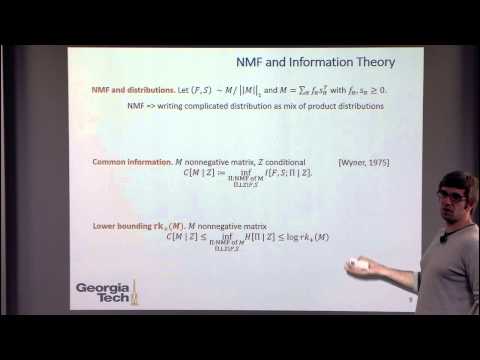
Describes a concrete pipeline that lowers bounds on LP sizes by turning an optimization problem into its slack matrix, interpreting that matrix as a distribution and bounding its nonnegative rank via an information measure called common information. Uses Hellinger-distance cut‑and‑paste identities and a direct‑sum condition to reduce to many constant‑size subproblems. Delivers exponential extension‑complexity lower bounds for the correlation polytope and shows matching LPs and many approximations still need exponentially many inequalities, so the method succeeds.

AI-written summary · about

  1. 0:00Start
  2. 1:42LPs capturing Approximation Problems
  3. 5:45Formulation Complexity
  4. 7:20Optimal LPS
  5. 9:39Information Theory: Summary
  6. 17:44NMF and Information Theory
  7. 22:24The correlation polytope
  8. 29:19Average case hardness for COR(n)
  9. 30:16The matching problem - a much more complicated case
~/search
type to search 6,249 conferences, 138,987 speakers and 185,172 talks
~/help
cmdctrl k
search every conference, speaker and series
/
focus the filter search
h
home
c
conferences
s
speakers
e
series
t
light / dark — the status bar button does the same
?
this help
esc
close this, then clear every filter — or just the search, while you are typing in it

Ignored while you are typing. Pages without a filter rail have no search to focus.