Rethinking testing and risk within complex systems – the Swiss Cheese Model
summary
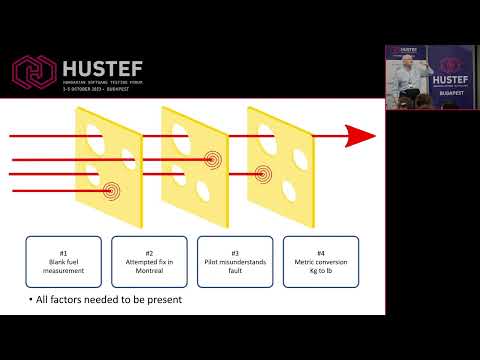
Uses the Swiss Cheese idea to show that four aligned failures (blank gauge, attempted midstop fix, crew change, metric conversion) cause catastrophe not a single bug; cites 55 changes in four months to explain operational overload and the surprising fuel mismatch 10,000 kg vs 22,000 kg. Shows the aircraft becomes a glider and human improvisation plus a lucky nosewheel collapse avert disaster, and recommends simulator training and checklists and system models because layered defenses and latent bugs obey a power-law risk.
AI-written summary · about
chapters (11)
- 0:00Introduction
- 0:48Speaker background
- 2:15Gimli Glider incident
- 8:39Degraded mode in systems
- 10:50Swiss Cheese Model
- 13:37Human interventions in Gimli
- 15:00Richard Cook’s principles
- 18:10Safety as system trait
- 19:57Learning from failure
- 20:38Conclusion
- 21:00Q&A
related talks
 32mRisk-Based Test Effort Management
 09mSystems Thinking for Testers
 40mResilience Testing - Failure is an Option
 43mOne Strategy, One Community: A deep dive into a Global Testing Transformation
 24mThe more we test, the worse?
 53mReady to Run the Risk? - Applying a Risk-Based Approach to Testing
 39mThe Good Testing, The Bad Testing and The Ugly Testing
 30mValue, Money, and Costs: The Ultimate Common Language for the Testing Strategy