Encryption-as-a-Service with Vault's Transit Secret Engine
summary
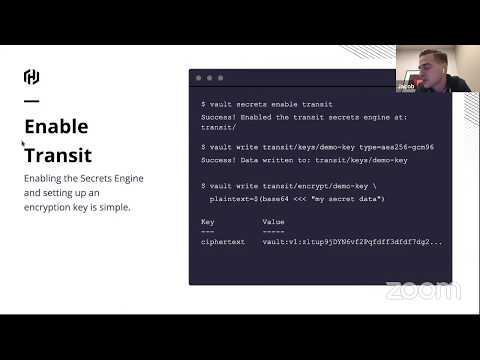
Vault Transit acts as encryption-as-a-service: keys never leave Vault, data is sent over TLS and Vault returns ciphertext for storage. Demo shows enabling the Transit secrets engine, creating keys (e.g. AES-256, RSA options), using the HVAC Python library and raw API calls to encrypt/decrypt base64 payloads, rotate keys and rewrap ciphertext, and enable convergent encryption for repeatable ciphertext used in indexed queries. Code and workflow are shown end-to-end with a PostgreSQL demo.
AI-written summary · about
chapters (13)
- 0:00Introduction to talk
- 0:22Why encrypt data in plain text
- 1:26Vault Transit Secrets Engine overview
- 3:08Transit engine features explained
- 7:03Developer workflow with Transit
- 10:54Enabling and setting up Transit
- 14:26Live demo setup
- 16:11Basic encryption and decryption
- 17:36Integrating Transit in Python
- 20:26Demo application in action
- 22:51Key rotation process
- 25:03Convergent encryption demo
- 26:25Summary and Q&A
related talks
 40mA Better Way To Manage Secrets
 51mIntroduction to Vault
 31mModern Security with Microservices and the Cloud
 41mModern Security with Microservices and the Cloud
 30mSimplifying Secrets Management in the Public Cloud
 26mVault + Distributed SQL: Protecting Data Where it Lives
 29mIntro to secrets management using Vault
 50mDevOps: Shhhh! It's a secret! - HashiCorp Vault