More Than Capacity: Performance-oriented Evolution of Pangu in Alibaba

summary
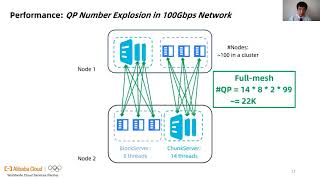
A global unified storage system evolves to deliver 100‑microsecond average latency by deploying a user‑space storage OS (USS OS), RDMA from 25Gbps to 100Gbps, and a redesign of file layout and RPCs to cut RPCs and context switches. Remote direct cache access (RDCA) bypasses DDR, CPU offload uses FPGA compression and NIC CRC, background TCP traffic shifts to RDMA to cut memory use ~75%, and network traffic amplification 66.3→2.9 yields a measured 6.1× throughput uplift and p99 write latency ≈1 ms.
AI-written summary · about
chapters (10)
- 0:00Intro
- 0:26Pangu: The Unified Storage Platform in Alibaba Cloud
- 2:35Storage Architecture based on Pangu2.0
- 3:30Performance Design Challenges for Pangu2.0
- 5:47Full Stack Optimization for Latency
- 7:28Methods to Guarantee Performance SLA
- 9:20Latency and SLA Evaluation
- 10:06Higher I/O Efficiency, Better Performance
- 11:02Breaking Network Bottleneck to Improve I/O Efficiency
- 11:54Breaking Memory Bottleneck to Improve I/O Efficiency
related talks
 11mWhen Cloud Storage Meets RDMA
 18mThe Evolution of High Performance Networks: A Storage Perspective and Practices
 05mKeynote: Innovation of the Network Infrastructure at Alibaba
 25mDisaggregating Persistent Memory and Controlling Them Remotely
 15mSecuring RDMA for High-Performance Datacenter Storage Systems
 19mEnhancement and Optimization of computing, storage & network for bare metal with hardware offloading
 25mShenango: Achieving High CPU Efficiency for Latency-sensitive Datacenter Workloads
 28mPersistent Memory plus RDMA, new age remote device