Efficient and Targeted COVID-19 Border Testing via Reinforcement Learning

summary
Reinforcement learning system Eva deploys at 40 Greek entry points in summer 2020, combining passenger origin and two‑week rolling PCR results to allocate about 7,500 tests/day by type and port. The system uses pseudo‑Gittins indices, certainty‑equivalent batch updates and empirical Bayes priors to handle nonstationarity, delayed pooled results and sparse positives, and it identifies about 1.85× more infections than random testing (2–4× at peak) and 1.25–1.45× versus country‑metric policies.
AI-written summary · about
chapters (8)
- 0:00Border testing project intro
- 5:22AVA testing platform
- 12:13Active feedback loop
- 23:29Exploration-exploitation trade-off
- 37:45Prevalence estimation with imbalanced data
- 46:05Reinforcement learning impact
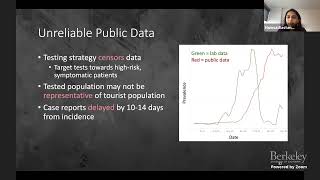
- 50:42Public data limitations
- 58:04Future policy insights
related talks
 32mCountry-Scale Bandit Implementation for Targeted COVID-19 Testing
 23mWhat cyber security can teach us about COVID-19 testing
 37mAI/ML Strategies & Techniques for a Post Pandemic World
 39mModel Based Testing Shifting Right into the Real World
 22mCOVID-19: Data Science & Expertise
 27mThe Journey from AI to Bedside: Translating Academic Research to Serving Patients Using Ray
 23mApplying AI and ML in the Current Pandemic World
 06mA City-Wide Crowdsourcing Delivery System with Reinforcement Learning