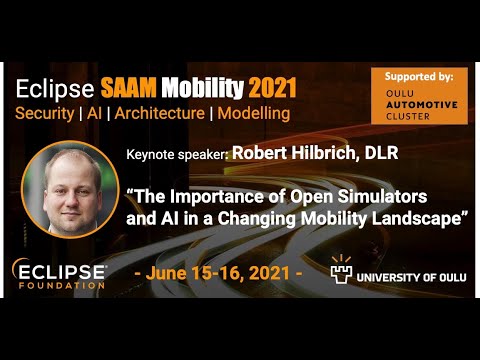
The Importance of Open Simulators and AI in a Changing Mobility Landscape
summary
Claims that open simulators plus AI can tame urban mobility complexity get concrete: digital twins built with Eclipse SUMO power reinforcement‑learning experiments (Flow from UC Berkeley) but real results are mixed — an accident classifier on a 200 km Chinese highway flags ~60% detection from April 2014’s 1,300 crashes yet struggles with rarity and false positives; traffic‑light RL needs heavy compute (one laptop yields 12 episodes in one day while improvements appear after ~20 days) and often produces long cycle times that fail real‑world expectations.
AI-written summary · about
chapters (14)
- 0:00Intro
- 7:12Success
- 14:30Challenges
- 17:45Results
- 20:43Our Results
- 22:05The Black Box
- 23:30Total Observation
- 24:38Challenge
- 27:52Changes
- 30:35What can you do
- 31:29Realtime data
- 31:57Conclusion
- 32:49Questions
- 33:32Getting started with simulation
related talks
 19mTestbed for Development of AI Solutions to Boost Operational Efficiency in Transportation Networks
 20mAI on the Fast Lane: Smart Traffic Systems to Unclog our Cities
 20mSimulating platooned connected autonomous vehicle in a large scale urban scenario
 24mTowards Smarter Intersections Through Digital Twins - The Coupling of SUMO and SCENIMINI
 29mSynthetic environment, the Internet of the next decade
 17mA Co-Simulation Middleware: Virtual Testing of Automotive Applications with Multiple Simulators
 55mSurviving the AI Testing Apocalypse
 24mLeveraging Eclipse SUMO and Eclipse MOSAIC