Accuracy Disparities and Social Choices in the Design of Privacy Mechanisms

Talkat Data Privacy: From Foundations to Applications (Simons Institute workshop, 2019) · 2019-03-04..03-08·
summary
Claims that common differential privacy pipelines produce uneven harms: applying Laplace mechanism to census-style counts yields unbiased equal-variance noise but post-processing and data-adaptive algorithms like DAWA reduce total error while introducing bias and much larger per-group variance, and the matrix mechanism can concentrate error unevenly across states. Case studies show 175 language-covered jurisdictions (263 covered in 2016) where at ε=10 most are stable but at lower ε many have very low correct-classification rates, and Title I funding shows small districts gain positive bias while large districts absorb the deficit.
AI-written summary · about
chapters (23)
- 0:00Intro
- 1:29Assignment problems
- 2:29Consequences of inaccuracy
- 3:13Alternatives for private assignment
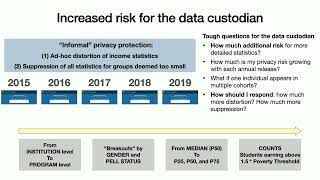
- 5:39Common statistical agency practices
- 7:03Social choice: accuracy vs. privacy loss
- 10:48Social choice: accuracy vs. accuracy disparity
- 11:15Remainder of the talk
- 11:41Accuracy disparities
- 17:42Laplace mechanism
- 18:24Alternative mechanisms
- 18:48Data-adaptive mechanisms
- 20:54Matrix mechanism: workload adaptivity
- 21:51Geographic hierarchy
- 22:48Accuracy on state counts
- 28:20Threshold assignment
- 29:14Outline
- 29:34Minority language voting benefits
- 31:53Covered jurisdictions
- 33:24Laplace vs. DAWA
- 39:39Allocation error
- 40:30Summary
- 41:40Next steps?
related talks
 42mDifferential Privacy
 30mAccuracy First: Selecting a Differential Privacy Level for Accuracy-Constrained...
 01h 07mStatistical Inference and Privacy, Part I
 20mShare data without revealing personal information
 10mCommunicating Differential Privacy Guarantees to Data Subjects
 01h 03mStatistical Inference and Privacy, Part II
 17mNegotiating Privacy/Utility Trade-Offs under Differential Privacy
 01h 00mPANEL: Statistical Theory, Privacy and Data Analysis